Killer Sudoku, the empty board challenge that math can solve

Image by Mohamed Marey retrieved from Unsplash
Killer Sudoku (or Sudoku Killer) is one of the most exciting and challenging variants of classic Sudoku. It combines the spatial positioning logic of traditional Sudoku with the basic arithmetic of Kakuro.
At first glance, the board can seem intimidating because there are no starting numbers filled in the grid. Instead, the board is divided into groupings of cells or “cages”, marked with colored or dashed lines, each featuring a small number in its top-left corner.
Myth says you need to be a mathematical genius to solve the most advanced levels in your head, but the reality is that Killer Sudoku doesn’t require supernatural skills, it requires deductive logical reasoning, data structuring, and knowing the Rule of 45 (the sum of numbers 1 through 9 in any row, column, or block is always 45).
Formal description of the problem
The goal of Killer Sudoku is the same as in regular Sudoku: fill each row, column, and $3 \times 3$ region once with the numbers from 1 to 9. The difference lies in how those numbers are deduced.
The specific rules of Killer Sudoku are as follows:
- You must fill all rows, columns, and $3 \times 3$ regions with numbers from 1 to 9, just like in standard Sudoku.
- Each cell is part of a cage, indicated by borders of different colors or dashed lines.
- The sum of the numbers inside each cage must equal the value shown in its top-left corner.
- Numbers cannot be repeated within the same cage.
- Numbers cannot be repeated within the same row, column, or $3 \times 3$ region.
To find the correct solution, we have the following initial board:
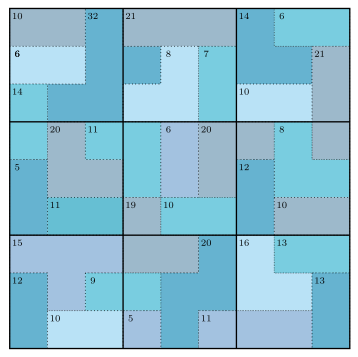
Would you like to try solving it logically before looking at its mathematical formulation?
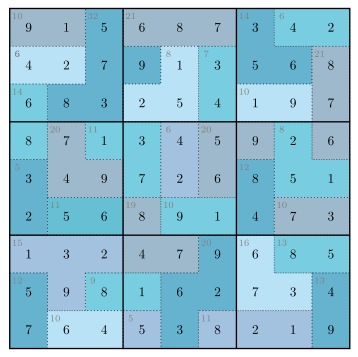
This problem can be formulated as a binary linear optimization model, do you dare to try it?
Want to keep exploring the world of Operations Research? Discover more posts on the topic here.
If you found this useful, please cite this as:
Martín-Campo, F. Javier (Sep 2026). Killer Sudoku, the empty board challenge that math can solve. https://www.fjmartincampo.com/blog/2026/sudokukiller/.
or as a BibTeX entry:
@misc{martín-campo2026killer-sudoku-the-empty-board-challenge-that-math-can-solve,
  title   = {Killer Sudoku, the empty board challenge that math can solve},
  author  = {Martín-Campo, F. Javier},
  year    = {2026},
  month   = {Sep},
  url     = {https://www.fjmartincampo.com/blog/2026/sudokukiller/}
}
Enjoy Reading This Article?
Here are some more articles you might like to read next: