The harmony of digits in solving Kakuro

Image by Mohamed Marey retrieved from Unsplash
Kakuro (popularly known as the number crossword) is one of the world’s most popular logic puzzles. It combines the spatial placement of Sudoku with classic arithmetic combinatorics.
Unlike conventional Sudoku, where the objective focuses on digit permutations, Kakuro requires analyzing numerical combinations that sum to an exact amount without repeating any digit in the same row or column.
Despite its apparent mathematical complexity, the game does not require supernatural skills, but rather deductive logical reasoning, data structuring, and basic combinatorics.
Formal description of the problem
The game is played on a grid made up of white cells (empty), black cells (blocked), and colored cells (with clues):
- You must fill each white cell with a single digit from 1 to 9 inclusive.
- Each continuous block of white cells (horizontal or vertical) has an associated sum clue located in the colored cell immediately to its left or above.
- The sum of the numbers in each block must equal exactly the assigned clue.
- No digit can be repeated within the same continuous block of white cells.
To determine the correct assignment, we have the following initial board:
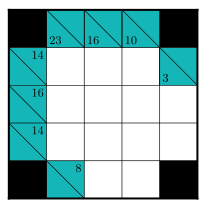
Would you like to try solving it logically before looking at its mathematical formulation?
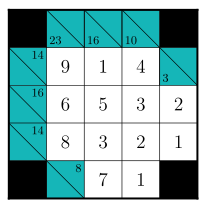
This puzzle can be formulated as a binary linear optimization model, do you dare to try it?
Want to keep exploring the world of Operations Research? Discover more posts on the topic here.
If you found this useful, please cite this as:
Martín-Campo, F. Javier (Sep 2026). The harmony of digits in solving Kakuro. https://www.fjmartincampo.com/blog/2026/kakuro/.
or as a BibTeX entry:
@misc{martín-campo2026the-harmony-of-digits-in-solving-kakuro,
  title   = {The harmony of digits in solving Kakuro},
  author  = {Martín-Campo, F. Javier},
  year    = {2026},
  month   = {Sep},
  url     = {https://www.fjmartincampo.com/blog/2026/kakuro/}
}
Enjoy Reading This Article?
Here are some more articles you might like to read next: