A crime has been committed... in a sudoku!

Image by Veer Mickey Shah retrieved from Unsplash
Murdoku is an ingenious logical deduction puzzle that blends the spatial constraints of classic Sudoku with a murder mystery narrative (Whodunit).
Unlike traditional Sudoku, where we fill cells with numbers from 1 to 9, in Murdoku we must place a set of suspects and the victim on a map representing the crime scene (rooms, furniture, and objects) to ultimately deduce who the killer is.
General rules of Murdoku
To solve a Murdoku case, five fundamental physical and logical rules must be respected:
- One person per row and column: Each row and each column of the grid can contain at most one person (whether a suspect or the victim). Once someone’s position is confirmed, that row and column are completely blocked for everyone else.
- The map as evidence: The board is not neutral; it is divided into colored areas or rooms and contains specific elements such as chairs, sofas, tables, plants, TVs, or bookshelves (depending on the crime to solve).
- Strict compliance with clues: Each suspect has their own clue (in addition to potential global clues) dictating their position relative to other suspects, rooms, or objects (e.g., “south of X”, “to the left of Y”, “the only person on a sofa”).
- The crime rule (Identifying the culprit): Once all people are placed on the map satisfying the clues and row/column constraints, the killer is the person who is alone with the victim in the same room or colored region.
- Interaction with furniture and objects:
- A person cannot be in a cell containing a table, plant, TV, barrel, bookshelf (or other similar objects).
- A person can be in a cell containing a bed or an armchair.
The night of the crime
A violent storm cut off the mansion’s power supply at midnight. Amidst the darkness, a brief struggle shattered the silence of the house. When the emergency lights turned on minutes later, the lifeless body of Victor lay on the floor.
The inspector in charge has cordoned off the property and recorded the positions of the nine people present in the mansion (the victim and eight suspects). Cross-referencing the floor plans of the various rooms, from the basement to the bathroom, with the statements of those present, the goal is to pinpoint each individual’s position with mathematical precision to uncover who cornered the victim. The floor plan of the mansion is as follows:
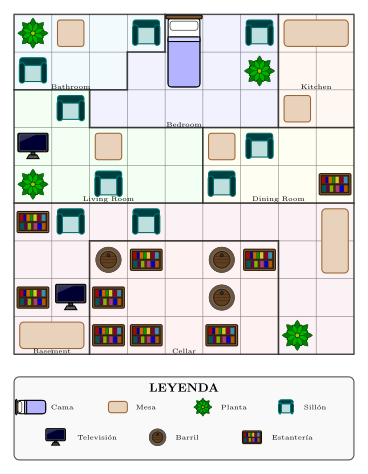
Case file
- Victim: Victor (V)
- Suspects: Alex (A), Bruno (B), Carolina (C), Diana (D), Eva (E), Fabian (F), Gabriel (G), Hector (H)
Case clues
- Clue 1 (Suspect A): Was not next to a table.
- Clue 2 (Suspect B): Was in the bottom row.
- Clue 3 (Suspect C): Was next to a bookshelf.
- Clue 4 (Suspect D): Was east of Bruno. Was not next to a table.
- Clue 5 (Suspect E): Was in the basement. Was not next to the TV.
- Clue 6 (Suspect F): Was alone. Was sitting in an armchair.
- Clue 7 (Suspect G): Was in the bathroom.
- Clue 8 (Suspect H): Was next to a table.
- Clue 9 (Victim V): Was alone with the killer.
- Global Clue 1: There was exactly one person in bed.
- Global Clue 2: There was no empty room.
- Global Clue 3: There were exactly two people sitting in an armchair.
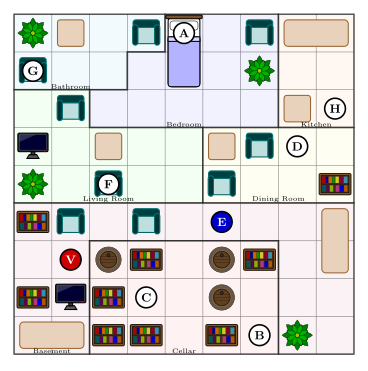
The puzzle can be formulated as a binary linear optimization model, do you dare to try it?
Want to keep exploring the world of Operations Research? Discover more posts on the topic here.
If you found this useful, please cite this as:
Martín-Campo, F. Javier (Sep 2026). A crime has been committed… in a sudoku!. https://www.fjmartincampo.com/blog/2026/murdoku/.
or as a BibTeX entry:
@misc{martín-campo2026a-crime-has-been-committed-in-a-sudoku,
  title   = {A crime has been committed... in a sudoku!},
  author  = {Martín-Campo, F. Javier},
  year    = {2026},
  month   = {Sep},
  url     = {https://www.fjmartincampo.com/blog/2026/murdoku/}
}
Enjoy Reading This Article?
Here are some more articles you might like to read next: