Dominosa is a fascinating logic game created by O.S. Adler in the late 19th century. Although placing domino tiles on a grid might seem simple at first glance, reconstructing the original layout of a complete domino set from a grid of revealed numbers poses a true combinatorial challenge.
The objective is to cover a rectangular board consisting of $R \times C$ numbered cells using a complete set of dominoes (from double zero $[0,0]$ to double $M$, $[M,M]$), such that each cell is covered by exactly half of a tile whose values match the numbers printed on the board.
Formal Problem Description
Given a complete set of domino tiles up to a maximum value $M$ (containing $N_d = \frac{(M+1)(M+2)}{2}$ tiles) and an $R \times C$ grid of numbers with $R \times C = 2 \cdot N_d = (M+1)(M+2)$ cells, we must place all tiles respecting the following rules:
Unique tile usage: Each tile $[u, v]$ from the complete set (with $0 \leqslant u \leqslant v \leqslant M$) must be used exactly once.
Complete, non-overlapping coverage: Each cell on the board must be covered by half of a single domino tile, leaving no empty spaces or overlapping tiles.
Physical adjacency: A domino tile occupies exactly two adjacent cells on the board, either horizontally or vertically.
Value matching: The two numbers on a domino placed over a pair of adjacent cells must match the values printed on those cells.
The key question we need to answer is: Does a valid placement of the complete domino set exist that perfectly covers the board, and how can we find it automatically?
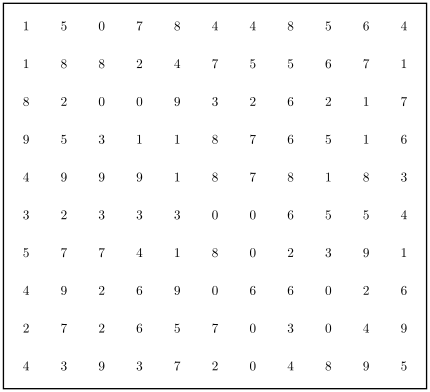
Consider the following example (using tiles from 0 to 9 on a $10 \times 11$ board):
Do you dare to solve it logically before taking on the model?
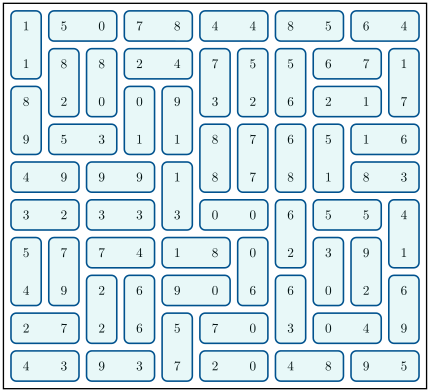
Puzzle Solution
By solving the binary linear programming model with the given number matrix, the solver instantaneously finds a valid reconstruction of domino tiles on the board:
This logic puzzle can be formulated elegantly and systematically as a Binary Linear Programming problem. Dare to try it?
To model Dominosa as a binary linear programming problem, we identify all potential positions where a tile could be placed (adjacent edges on the board) and link each position to its corresponding domino tile based on the values of its cells.
\(\mathcal{M} = \{0, 1, \dots, M\}\): Possible numerical values of the domino tiles.
\(\mathcal{D} = \{[u, v] \in \mathcal{M} \times \mathcal{M} : u \leqslant v\}\): Set of tiles in the complete domino set (avoiding duplicates due to symmetry).
\(\mathcal{E} = \{ ((i,j), (r,c)) \in (\mathcal{I} \times \mathcal{J})^2 : |i-r| + |j-c| = 1, \; (i,j) < (r,c) \}\): Set of ordered pairs of adjacent cells on the board, under lexicographical order $(i,j) < (r,c) \iff i < r \lor (i = r \land j < c)$.
\(\mathcal{E}_{uv} = \{ ((i,j), (r,c)) \in \mathcal{E} : \{V_{ij}, V_{rc}\} = \{u, v\} \}\): Set of board positions whose numerical values match tile $[u,v]$.
Parameters
\(V_{ij} \in \mathcal{M}\): Number printed on cell $(i,j)$ of the board.
\(R, C\): Number of rows and columns of the board, where $R \times C = 2 \cdot N_d = (M+1)(M+2)$.
Decision Variables
\(x_{ijrc} = 1\) if a domino tile is placed on the adjacent edge $((i,j), (r,c)) \in \mathcal{E}$, and $0$ otherwise.
Since this is a feasibility problem (finding any configuration that satisfies all game rules), the objective function is arbitrary:
Objective Function
\[\min z = 0\]
We formulate the rules of Dominosa as linear constraints:
Exact coverage per cell:
Each cell $(i,j)$ on the board must be covered by exactly one domino tile (summing edges where the cell is either the first or second element of the ordered pair):
Martín-Campo, F. Javier (2026). Dominosa, Beyond Dominoes. https://www.fjmartincampo.com/blog/2026/dominosa/
As a BibTeX entry:
@misc{martín-campo2026dominosa-beyond-dominoes,title={Dominosa, Beyond Dominoes},author={Martín-Campo, F. Javier},year={2026},month={jun},url={https://www.fjmartincampo.com/blog/2026/dominosa/}}